Mexico’s Reverse Capital Gains Tax
A plain-English guide for U.S., Canadian and other foreign buyers.
September 16, 2026
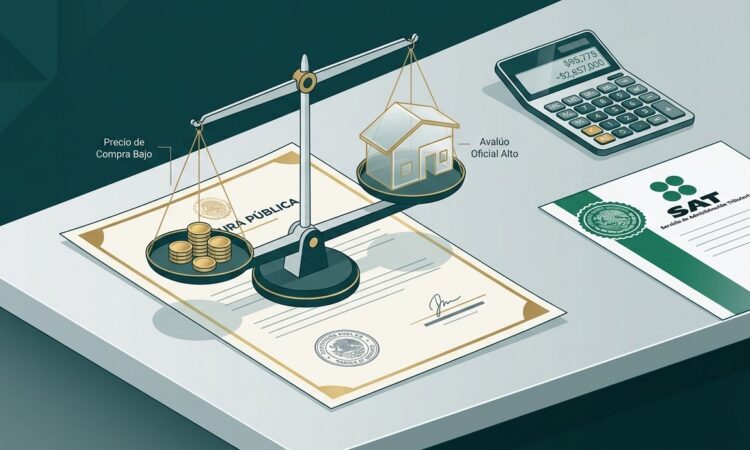
If you’re buying property in Mexico, you’ve probably heard that sellers owe capital gains tax when they sell. What catches most American, Canadian and other foreign buyers off guard is that Mexico also has a tax that can hit the buyer — at the moment you purchase, not when you eventually sell. Real estate professionals call it “reverse capital gains” or “acquisition capital gains.” The Mexican tax authority (SAT) calls it ISR por Adquisición de Bienes — income tax on the acquisition of assets.
The short version: if you buy a property for significantly less than its official appraised value, Mexico treats that gap as taxable income to you, the buyer — and taxes it immediately, at closing.
Where This Tax Came From, and Why It Exists
This isn’t a quirky new rule — it’s a fix for a very old problem. For decades, it was common for a buyer and seller in Mexico to agree, informally, to record a lower price on the official deed (the escritura or Fedeicomiso) than what actually changed hands.
Both sides benefited: the seller owed less capital gains tax (ISR) on their reported profit, and the buyer owed less local acquisition tax (ISAI, typically 2–5% of the price) at closing. The government, meanwhile, collected less tax on both ends of the same transaction.
Mexico’s response was to make under-reporting financially painful for the buyer, not just the seller. If a property’s official appraisal comes in well above the price on the deed, the buyer is deemed to have received a financial benefit — essentially, a “gift” of the difference — and owes federal income tax on it. Buyers challenged this for years, arguing it taxes a paper gain on an asset they haven’t sold. Mexico’s Supreme Court settled the question, ruling the tax constitutional and proportional. It remains in force today, under Articles 125 and 130 of Mexico’s federal Income Tax Law (LISR).
The upshot: this law exists to close a loophole, not to penalize honest buyers. Once you understand the mechanics, it’s a manageable, predictable part of closing costs — not a trap.
How the Tax Actually Works
At closing, a government-certified appraiser (a perito valuador) produces an official commercial appraisal of the property. The Notario handling your closing (the Notario Público, who also acts as the tax-withholding agent) compares that appraisal to your actual purchase price.
The 10% rule: if the appraisal is no more than 10% above your purchase price, nothing is triggered. If it’s more than 10% above your purchase price, the entire difference is treated as taxable income to you.
Example: You buy a condo for $500,000 USD. An appraisal up to $550,000 (the 10% buffer) is fine — no tax. But if the appraisal comes back at $600,000 (20% above your price), the full $100,000 gap is taxed as your income, not just the portion above the buffer. This example is simplified for explanatory purposes. Property in Mexico is manifested in Pesos and all tax calculations are in Pesos.
The Notario is required to withhold this tax at closing and pay it directly to the SAT within 15 days — you don’t get to defer it or pay it later.
TAX RATES
| Buyer Status | Rate | How It’s Applied |
| Mexican resident taxpayers | 20% flat | A provisional payment. It’s reconciled on the buyer’s annual tax return, credited against whatever their final rate turns out to be (up to 35%). |
| Foreign buyers | 25% flat | A final payment, collected in full by the Notario at closing. No deductions, no reconciliation — this is what most U.S. and Canadian buyers will pay. |
The Cadastral Floor: Why the Appraisal Can Never Go Below Municipal Value
There’s a second number worth knowing besides the appraisal: the municipal cadastral value (valor catastral) — the local tax authority’s official baseline for the property, used to calculate annual property tax (predial). Mexican municipal tax codes (Leyes de Hacienda Municipal) set a strict rule for transfers: the local acquisition tax (ISAI) is always calculated on whichever is highest of three figures — the contract sales price, the commercial appraisal, or the cadastral value.
Because the cadastral value acts as a legal floor, a certified appraiser (perito valuador) cannot deliver a commercial appraisal below it. Municipalities publish mandatory minimum land and construction values per square meter, valuation standards cap how far a property’s condition can pull those numbers down, and the digital registry itself will reject a filed appraisal that comes in under the active cadastral record. An appraiser who tries anyway risks having the filing bounced by the municipal treasury and their own license flagged for audit — so in practice, no appraisal will ever land below this baseline, no matter how outdated or unfair the cadastral number looks.
This has a direct consequence for the reverse capital gains tax: if your purchase price is more than 10% below the cadastral value, the appraisal simply cannot come in low enough to keep you under that threshold, and the acquisition tax is triggered — regardless of how legitimate the discount is or how the appraiser feels about the deal. A rock-bottom purchase price will not produce a rock-bottom appraisal to match.
The Appraisal: Who Handles It, and How Long It Lasts
You, the buyer, pay for the appraisal — it’s a standard closing cost. But the Notario is the one who officially orders it and must use a licensed perito valuador registered with both the state and the SAT.
The appraiser doesn’t just eyeball the property. Mexican valuation standards require blending three approaches: comparing recent sales and active listings in the area, calculating the replacement cost of the land and construction, and (for rental or commercial property) projecting income potential. Because Mexico’s public sales records are historically unreliable — for the same under-reporting reasons this tax exists — appraisers also lean on municipal land-value tables and current construction-cost indexes as a floor.
Validity window: an appraisal is only good for 6 months (180 days) from its issue date. If your closing is delayed past that — trust setup, permits, financing — you’ll need a new appraisal, and the numbers could have moved.
You Can’t Skip the Appraisal
Some buyers assume a private, off-the-books sale avoids all this. It doesn’t.
- No appraisal, no deed. Notarios are personally liable if they sign off on a transfer without properly calculating taxes, and Mexico’s digital registry system won’t even generate the closing paperwork without the appraiser’s license number and appraisal ID entered into the system. Skip the appraisal, and the property legally can’t be transferred into your name.
- A private sale doesn’t make the tax go away. If you and the seller sign a private agreement and skip the Notario, the tax obligation technically still applies from the moment of purchase. If the SAT later discovers the transaction — through bank records, or when you eventually try to sell — they can perform their own retroactive appraisal, apply the tax, and add penalties of up to 90% of what was owed, plus interest.
A Tricky Case: Genuine Distressed Sales
Occasionally a property really is sold at a loss — a bank foreclosure, a motivated seller, storm damage. This creates a mismatch worth understanding before you make an offer:
- The seller owes nothing in capital gains tax if the real sale price is genuinely below their cost basis — that’s a legitimate, documented loss.
- The buyer can still get caught by the reverse gains tax, because the property’s official appraisal (and the municipal cadastral value used for local taxes) will likely still be well above the discounted price you’re paying.
Because a below-market sale price can also look like classic tax-evasion under-reporting, Notarios scrutinize these deals closely and will want documentation — the seller’s original deed, and a clearly justified appraisal explaining the lower value (storm damage, deferred maintenance, zoning issues, etc.). But the cadastral floor still applies here too: no matter how much genuine damage or depreciation the appraiser documents, the appraisal cannot be written below the municipal cadastral value.
Important: even when a Notario is personally convinced a distressed sale is completely legitimate, they cannot waive this tax. Mexican Notarios have no discretion here — they’re withholding agents for the SAT, carry personal financial liability for taxes they fail to collect, and the digital tax portal calculates the amount automatically with no override. If you’re buying a genuine bargain, plan for this tax rather than hoping to talk your way around it.
How to Protect Yourself
None of this needs to derail a good deal — it just needs to be planned for, ideally before you sign a purchase contract and choose to move past the due diligence phase:
- Get a preliminary appraisal early. Have a certified appraiser assess the property during your due diligence period, before you’re locked into a price, so you know whether you’re within the safe 10% window.
- Check the municipal cadastral value too. Since the appraisal can never legally come in below it, the cadastral value is a hard floor on your exposure — treat it as your practical benchmark, not just the appraisal itself.
- Use a well-documented appraisal on fixer-uppers. If a property genuinely needs significant work, a thorough appraisal can legitimately depreciate the construction value and bring the appraisal closer to your price — reducing or eliminating the taxable gap.
Bottom Line
For U.S. and Canadian buyers, the reverse capital gains tax is best treated as a standard line item to budget for — similar to how you’d budget for closing costs or transfer taxes back home — rather than a red flag about the Mexican market. The key is timing: get an appraisal during due diligence, not after you’ve already signed at a price that turns out to be well below market. Work with an experienced local agent and a Notario early in the process, and this tax rarely becomes a surprise.
This document is a general summary for informational purposes and is not legal or tax advice. Rules, rates, and thresholds can change, and individual circumstances vary. Buyers should confirm current requirements with a Mexican Notario Público or a qualified Mexican tax attorney before closing.