Why HOAs in Mexico are different
A plain-English guide for U.S., Canadian and other foreign buyers.
September 29, 2026
For readers that want to get a basic understanding this synopsis has been included up front. Read the entire blog for the full context.
Synopsis
A Mexican HOA is legally called a Régimen de Condominio — a structure registered with the state it is located in. Two documents govern it: the master deed, which sets each owner’s percentage share of the common areas (the indiviso, the basis for your dues), and the Reglamento, the community’s actual rulebook. Three groups run it: the Homeowners Assembly (all owners, the top authority), the Surveillance Committee (owners elected to keep an eye on things), and the Administrator — usually a separate nonprofit company called a Civil Association, or A.C., since Mexico’s tax authority won’t recognize the HOA itself as a taxpayer. The A.C. may also hire a manager to handle daily operations, but none of these bodies can override the bylaws or outrank the Assembly.
Dues are billed are based on your indiviso which is legally defined in the Régimen de Condominio, usually quarterly, with a short grace period before late interest kicks in; falling far enough behind can cost you your vote at Assembly meetings and can even lead to court action, including a forced sale. Changing the bylaws or the dues formula takes a large supermajority vote. The system is more tightly tied to public law than a U.S. HOA and works fairly similarly to Canada’s condo and strata rules — except that in Mexico the A.C., not the HOA itself, is the real legal and tax entity, and the Surveillance Committee acts as a built-in watchdog.
Why HOAs here are different
If you’re buying property in Los Cabos, chances are you’re buying into a community governed by a homeowners association. If you already own property in the U.S. or Canada, some of this will look familiar. Some of it won’t. Mexican HOAs run on a different legal system, with different tools for collecting dues and different protections for owners. This guide explains how the system actually works, starting with why it exists in the first place.
History and Purpose
In Mexico, what English speakers call an “HOA” is legally known as a Régimen de Condominio, or Condominium Regime. It is not a private club created by a developer’s sales contract, the way many U.S. HOAs begin. It’s a formal legal structure, created under state civil law (in Los Cabos, the law of Baja California Sur) and recorded with the government before units are ever sold.
The purpose is straightforward: whenever a development is divided into individually owned units alongside shared spaces — pools, roads, gatehouses, landscaping, water systems — someone has to own those shared spaces jointly, pay for their upkeep, and agree on rules for using them. Mexican law requires the developer to spell all of this out in a public legal document before the first sale closes, so buyers know exactly what they’re joining.
The system has also evolved to solve a practical problem. For years, Mexican tax authorities would not issue a tax ID or allow a bank account to be opened in the name of a bare “Condominium Regime,” because it isn’t a company. Starting around 2016 in Baja California Sur, communities began solving this by forming a separate nonprofit corporation — a Civil Association, or A.C. — to hold the HOA’s bank accounts and act as its administrator. That workaround is now standard practice, which is why many Los Cabos communities have both a Condominium Regime and an affiliated A.C. working alongside it.
The bottom line: the goal is the same one you’d recognize from home — shared costs, shared maintenance, and an agreed set of rules. What’s different is that in Mexico, that agreement is a matter of public record and state civil law, not a private contract between a developer and homeowner.
The Legal Framework
Two documents define every Mexican HOA:
- The Master Deed (Escritura Constitutiva). Drafted by the developer and filed with a Notario Público and the state Public Registry of Property, this document lays out the property boundaries, the individual units, the shared common areas, and each owner’s indiviso — their percentage of undivided interest in the common areas, calculated from the size of their unit relative to the whole.
- The Bylaws (Reglamento de Condominio). Attached to the master deed, these are the community’s actual rulebook — pet policies, rental restrictions, architectural rules, dues, and conduct. Every buyer legally agrees to these rules the moment they purchase, whether they’ve read them or not.
Because both documents are publicly registered and tied to state condominium law, a board has far less room to invent new rules on the fly than boards often do in the U.S. Any rule or fine has to trace back to what’s actually written in the Reglamento, and major changes — amending bylaws, changing the administration — require following procedures established in the Reglamento and recorded in notarized minutes to be legally valid.
Who’s in Charge: The Three Governing Bodies
A Mexican condominium regime is run by three distinct bodies, similar in spirit to corporate governance: the Homeowners Assembly, the Surveillance Committee, and the Administrator. In most Los Cabos communities, the Administrator may itself be a separate corporation — a Civil Association — with its own internal governance layered underneath it, and many of those A.C.s also contract a professional Contract Manager to handle daily operations. Both are covered in detail below.
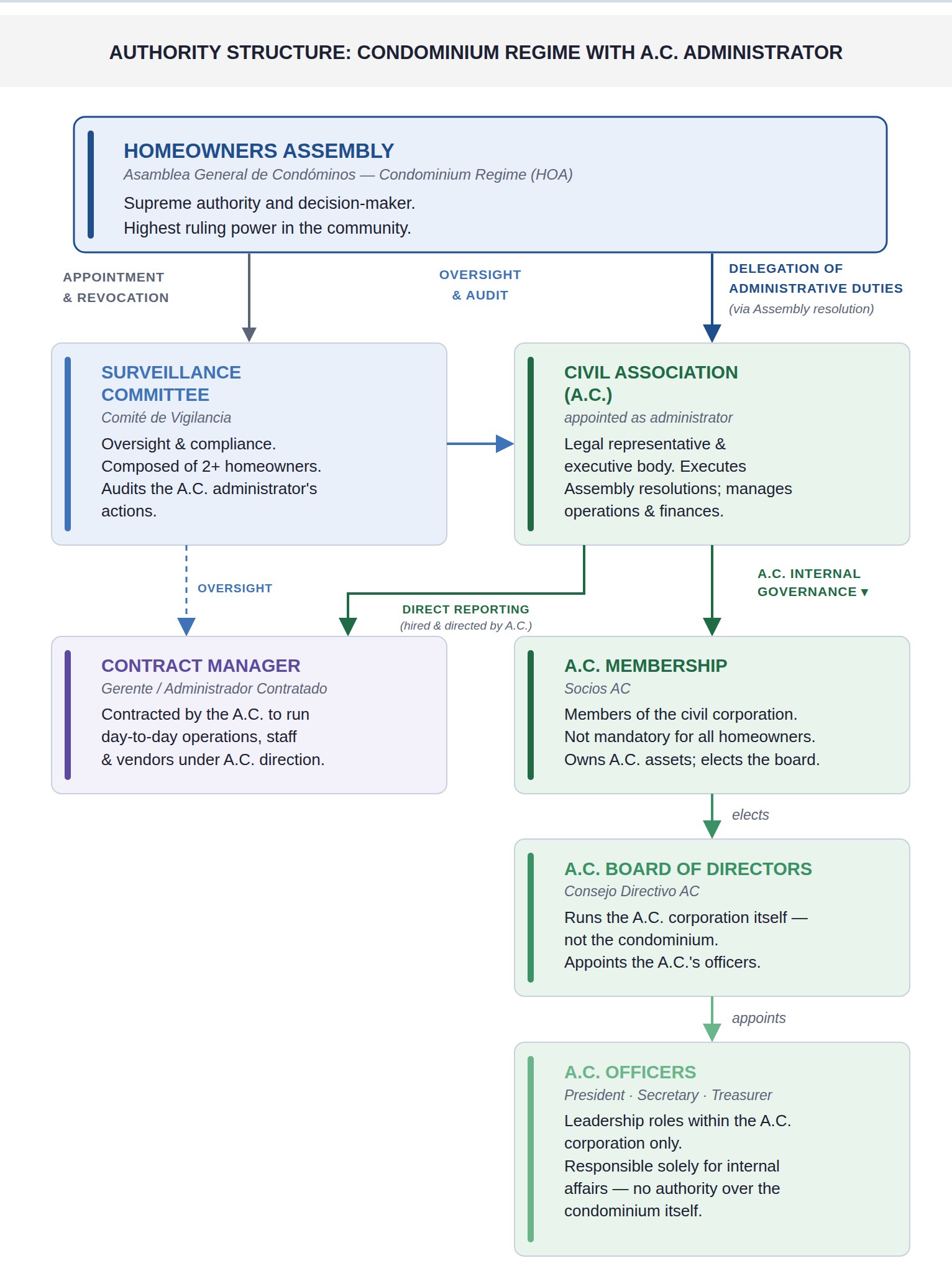
1. The Homeowners Assembly (Asamblea General)
This is the supreme authority — all owners, collectively. Ordinary Assemblies meet at least once a year to approve budgets, review finances, and elect the board. Extraordinary Assemblies are called for bigger decisions: amending the bylaws or master deed, approving major uninsured repairs, or removing the Administrator.
2. The Surveillance Committee (Comité de Vigilancia)
Two or more owners, appointed and removable by the Assembly, whose job is to audit the administrator — whether that’s an individual, a management company, or an A.C.: reviewing bank statements and expenses, checking that decisions match what the Assembly actually approved, and flagging problems. Committee members cannot also serve as the administrator — the law requires that separation.
3. The Administrator
The Assembly appoints someone to run day-to-day operations — maintenance, security, staff, budgets, and collections. This can be an individual, a professional management company, or — very commonly in Los Cabos — a Civil Association (Asociación Civil, or A.C.) that the Assembly appoints as administrator by resolution.
3.1 The Civil Association
Why communities use an A.C. The condominium regime itself is created under state civil law — that’s how the state recognizes the community’s property structure and its Assembly, Administrator, and Surveillance Committee. But Mexico’s federal tax authority, the SAT (Servicio de Administración Tributaria), doesn’t recognize a bare “Condominium Regime” as a legal entity capable of holding its own tax ID, opening a bank account, signing contracts, hiring staff, or issuing and receiving invoices. That’s a real disconnect between what state condominium law creates and what federal tax and banking rules will actually transact with — a condominium regime is a valid legal structure for governing the property, but not, on its own, a taxpayer. A civil association is a nonprofit corporate form that federal law does recognize, so it can obtain its own tax ID from the SAT and function as an ordinary legal entity. Forming one and appointing it as administrator is how communities bridge that gap: the condominium regime remains the structure that governs the property under state law, while the A.C. becomes the entity that actually banks, contracts, and pays taxes on the community’s behalf.
The A.C. is its own corporation. Once appointed, the A.C. is a completely separate legal entity from the condominium regime, with its own bylaws and its own internal governance:
- A.C. Membership (Socios). The formal members of the civil corporation. Membership isn’t automatically the same thing as owning a unit — not every homeowner is necessarily a member, though in practice the two groups usually overlap closely. The membership owns the A.C.’s corporate assets and elects its board.
- A.C. Board of Directors (Consejo Directivo). Elected by the membership, the board runs the A.C. as a corporation — its bank accounts, contracts, and staff — not the condominium itself. Its authority over the condominium extends only as far as whatever the Assembly has delegated to the A.C. as administrator. The board, in turn, appoints the A.C.’s officers.
- A.C. Officers (President, Secretary, Treasurer). Leadership titles inside the A.C.’s own corporate structure, responsible for its internal affairs — signing on its bank accounts, keeping its corporate records, and so on. They have no independent authority over the condominium; whatever authority they exercise there flows through the A.C. as a whole, which in turn flows from the Assembly.
Whatever its internal structure, the boundary is the same one that matters to homeowners: the A.C.’s board and officers can run the A.C.’s own corporate affairs, but they cannot override the condominium’s bylaws, change the master deed, or act as a higher authority than the Homeowners Assembly — no matter what title its officers hold.
3.2 The Contract Manager
Many A.C.s, especially in larger communities, hire a professional Contract Manager (sometimes called an on-site or property manager) under a services contract to handle the hands-on, day-to-day work of running the complex: supervising maintenance staff and outside vendors, overseeing security, coordinating landscaping and pool service, fielding routine resident requests, and executing the budget the Assembly has already approved.
The Contract Manager’s authority is minimal, and entirely operational rather than governing. They aren’t elected by owners, don’t sit on the A.C.’s board, can’t vote at an Assembly, and have no independent decision-making power beyond what their services contract and the Assembly-approved budget already spell out. They’re hired, supervised, and can be dismissed by the A.C.’s board, and every action they take has to stay within the budget and rules the Assembly has approved. In smaller communities, an A.C. officer may handle this work directly; as a property grows, contracting it out is a common way to separate the A.C.’s corporate and legal responsibilities from the practical business of running the community day to day.
The Indiviso: How Your Share — and Dues — Are Set
Every private unit in a Mexican condominium carries an indiviso: a fixed percentage of undivided interest in the complex’s common property. It isn’t a rough allocation — it’s a specific number, set out unit by unit in a chart attached to the master deed itself, typically calculated from each unit’s size relative to the total built area of the complex. For a complex of houses, the indiviso is typically based on lot square meters. For a complex of apartment condominium units, the indiviso is typically based on unit square meters. That percentage is what your share of the dues and your share of the reserve fund get calculated from.
Dues are billed against that percentage, not as a flat per-unit fee. Common contributions — the money that funds maintenance, staff, insurance, and the reserve fund — are billed to each owner in proportion to their indiviso, under whatever collection procedure the community’s Rules and Regulations set out.
The indiviso is the default method, but it isn’t the only one Mexican condominium law allows. A developer can set up a regime with a different allocation formula for ownership share and dues from the outset. What makes any such approach legal isn’t the formula itself — it’s whether that formula is actually written into the registered master deed and Rules and Regulations, either from the start or added later through the formal amendment process described below. An allocation method that is actually being used to assign ownership share or bill dues, but that doesn’t appear in those registered governing documents and was never adopted through that formal amendment process, isn’t a legitimate variation — it’s simply illegal, no matter how long it’s been in use or how routine it has become.
Amending the Regime or the Dues Formula: What It Takes
The indiviso and the dues formula built on it live inside the master deed and the Rules and Regulations, so changing either one counts as amending the regime itself — and Mexican condominium law sets that bar high on purpose. Many communities require a near-unanimous quorum and a supermajority vote — sometimes all homeowners present or represented, with 75% or more voting in favor — well above what an ordinary resolution needs, since routine assembly decisions typically pass by simple majority.
Two things are worth knowing before you buy. First, many bylaws suspend an owner’s right to vote or be heard at the assembly while they’re behind on dues — so a dues dispute can cost you your voice in exactly the vote you’d want to influence. Second, while the developer still holds a majority of the units by value, some bylaws let it modify the operating budget on its own, without an assembly vote — a right that typically ends once its ownership share drops below that majority.
Payment of Dues and Late Fees
Dues are usually billed and collected on a regular cycle — quarterly is common in Los Cabos — funding two separate pools: an operating fund that pays the complex’s routine costs (administrator’s salary, security, maintenance, insurance, common-area utilities) and a reserve fund set aside for larger, common-area expenses rather than day-to-day operations.
The administrator bills each owner’s share at the start of the billing period, calculated against that owner’s indiviso and the assembly-approved budget. Bylaws typically set a grace period — often just a couple of weeks — before late charges start; once it closes, interest accrues monthly, sometimes at rates in the range of several percent per month, compounding until the balance is paid.
If an unpaid account threatens the complex’s cash flow, some bylaws let the administrator spread the shortfall across the other owners, proportional to their own indiviso, to keep operations funded, then reimburse them once the delinquent balance is collected.
Persistent non-payment can escalate to formal collection: many Reglamentos allow the administrator, with the assembly’s authorization, to pursue legal action against a delinquent owner — up to and including forcing the sale of the unit — to recover the unpaid dues, late charges, and legal costs. This is generally a court process, not something the HOA can do unilaterally, and it typically requires supporting documentation such as the outstanding bills, the Rules and Regulations, and the assembly minutes that set the dues.
Accountability: If HOA Leadership Oversteps
Boards and A.C. officers who exceed their authority — mismanaging funds, ignoring the bylaws, or acting without proper approval — can be held accountable in two separate ways, because the A.C. and the condominium regime are legally distinct:
- Within the A.C. itself, its own members can call a corporate meeting and vote to remove and replace board officers, following the A.C.’s own bylaws.
- Within the HOA, the Homeowners Assembly — the true supreme authority — can revoke the A.C.’s appointment as administrator entirely, regardless of what happens inside the A.C.’s own corporate structure, and appoint a replacement.
The Surveillance Committee plays a key role here: if a board or A.C. president refuses to call a meeting or stonewalls accountability, the committee has the authority to directly summon an Extraordinary Assembly to present the issues to all owners.
Beyond removal, board members and administrators who act outside their authority can face personal civil liability for damages, and in serious cases — misappropriating funds, for example — criminal charges for fraud or abuse of trust.
A few decisions can never be made by an administrator, an A.C., or the Surveillance Committee alone — they require a vote of the full Homeowners Assembly: approving the annual budget or setting dues, levying special assessments, selling or encumbering common property, appointing or removing the administrator or surveillance committee, approving exterior or structural changes to a home, and forcing the sale of a delinquent owner’s property.
How This Differs From HOAs in the U.S. and Canada
Compared with U.S. HOAs
- A Mexican HOA is a publicly recorded legal structure created under state civil law, not a private agreement drafted by a developer.
- Boards have less freedom to invent rules. Anything they enforce has to trace back to the registered bylaws.
- Major governance changes require notarized minutes to be legally valid.
Compared with Canadian Condo and Strata Corporations
Canadian buyers will find the Mexican system more familiar than Americans do. Like Mexico, Canada regulates condominiums at the provincial level rather than federally. Ontario and Alberta use condominium corporations governed by a board of directors, and British Columbia uses strata corporations governed by a strata council. The vocabulary differs, but many of the pieces line up:
| Mexico (Baja California Sur) | Ontario / Alberta | British Columbia | |
| Governing law | State condominium law | Condominium Act, 1998 (ON); Condominium Property Act (AB) | Strata Property Act |
| Legal entity | Condominium Regime, usually with an A.C. for banking and taxes | Condominium corporation | Strata corporation |
| Founding documents | Master deed and Reglamento | Declaration, by-laws, and rules | Strata plan, bylaws, and rules |
| Your ownership share | Indiviso | Common interest percentage (ON); unit factor (AB) | Unit entitlement |
| Supreme authority | Homeowners Assembly | Owners at general meetings | Owners at general meetings |
| Who manages | Administrator (often an A.C.) | Elected board of directors | Elected strata council |
| Independent oversight | Surveillance Committee | Auditor, owners, and provincial tribunal | Owners and Civil Resolution Tribunal |
| Day-to-day operations | Contract Manager | Condominium manager (licensed in ON) | Strata manager |
| Collecting unpaid dues | Court action | Statutory lien, enforced like a mortgage | Statutory lien, with a court-ordered sale as the last resort |
Five differences matter most in practice.
The community itself is the legal entity in Canada, but not in Mexico. Registering a Canadian condo or strata plan automatically creates a corporation that can bank, sign contracts, and hire staff. A Mexican condominium regime governs the property under state law, but Mexico’s federal tax authority won’t recognize it as a taxpayer. That gap is why most Los Cabos communities form a separate Civil Association.
Power sits in a different place. A Canadian board or strata council actually runs the corporation between owners’ meetings. It sets priorities, approves contracts, and makes most operating decisions. A Mexican administrator, even one that is an A.C. with its own board and president, is an executor. Its job is to carry out what the Homeowners Assembly has already decided, not to govern the community.
Oversight is built in rather than bolted on. Canadian owners rely on audited statements, the right to call a meeting and remove directors, and provincial tribunals to hold boards accountable. Mexico adds a standing watchdog, the Surveillance Committee. It is a small group of owners whose ongoing job is to audit the administrator and call an Extraordinary Assembly if something goes wrong.
The supermajority culture will feel familiar. Canadians who have voted on a bylaw change know how high the bar can be. BC requires a 3/4 vote, and Alberta requires 75% of all owners holding 75% of unit factors. Mexican regimes are similar: amending the master deed, the Reglamento, or the dues formula typically takes a supermajority well above a simple majority.
Collections work differently. In Ontario and BC, unpaid fees give the corporation a statutory lien on the unit that can ultimately lead to a sale. In Ontario, that lien even ranks ahead of the mortgage. In Mexico, the path runs through the courts, usually via a summary collection lawsuit, and a forced sale requires a court process rather than a lien the HOA can enforce on its own. The consequence Canadians will recognize is the same in both countries: falling behind can cost you your vote at owners’ meetings.
The bottom line for Canadian buyers: expect a system you partly know, with owners in charge, registered governing documents, supermajorities for big changes, and professional managers who answer to someone else. The two things to get used to are an administrator who executes rather than governs, and a Surveillance Committee whose job is to keep that administrator honest.
Practical Takeaways for Foreign Buyers
- Before you buy, consider getting the Reglamento and master deed and have a bilingual attorney review them — rental rules, pet policies, and dues formulas vary community to community.
- Know the numbers. Ask for the current indiviso, quarterly dues, reserve fund balance, and history of special assessments.
- Show up (or send a proxy) to the annual Ordinary Assembly — that’s where budgets, dues, and board elections are decided.
- Staying current protects more than your wallet. Falling behind on dues can cost you your right to vote or be heard at the assembly, on top of the late fees.
- If something looks wrong — financial irregularities, a board acting outside its authority — the legal path is the Surveillance Committee and the Homeowners Assembly, not an informal dispute.
What Ultimately Makes an HOA Work
Everything above describes the legal machinery. But that machinery still runs on people. Homeowners associations succeed or fail based on the integrity, communication, and involvement of the A.C.’s leadership, the Surveillance Committee, and the residents who engage with them.
- Quality of Leadership: Owners elect the Surveillance Committee, so a responsible, engaged Committee is what keeps A.C. leadership — an appointed, administrative function — operating fairly, with transparent financial reserves and a focus on community well-being rather than arbitrary control.
- Resident Participation: Communities with active, informed homeowners generally prevent rogue A.C. leadership from taking over, and give the Surveillance Committee the backing it needs to hold that leadership accountable — ensuring rules match the actual desires of the neighborhood.
The legal structure covered in this guide sets the rules of the game. Whether an HOA is a pleasure or a headache to live under comes down to how well the people inside that structure — the Surveillance Committee, A.C. leadership, and residents alike — actually use it.
This guide is for general information only and is not legal advice. Condominium law varies by state, and every community’s registered master deed and bylaws control the specifics — including the exact indiviso percentages, quorum and voting thresholds, grace periods, and late-fee rates that apply to any given property. Buyers should have a Mexican attorney review the governing documents of any specific property before purchase.
Answers to Frequently Asked Questions
Legally, it’s a Régimen de Condominio, or Condominium Regime — a structure created under state civil law and recorded with the government before any units are sold. Unlike a typical U.S. HOA, it isn’t a private contract the developer wrote; it’s a public legal structure, so a board has far less room to enforce anything that isn’t actually written in the Reglamento.
Because Mexico’s federal tax authority, the SAT, won’t recognize a bare Condominium Regime as a taxpayer — it can’t get a tax ID, open a bank account, or sign contracts in its own name. Communities solve that by forming a Civil Association (A.C.), a nonprofit corporation the SAT does recognize, and appointing it as the condominium’s Administrator.
Not exactly. The A.C. is its own legal entity, separate from the condominium regime, with its own Members, Board of Directors, and Officers. It can run its own corporate affairs, but its authority over the condominium itself only extends as far as whatever the Homeowners Assembly has delegated to it — it can never override the bylaws or outrank the Assembly.
It’s your unit’s fixed percentage of undivided interest in the complex’s common property, set out in the master deed and typically based on your unit’s or lot’s size relative to the whole. It’s the number everything else is calculated from: your share of the dues and your share of the reserve fund.
Against your indiviso — owners with a larger percentage share pay proportionally more. Some developers will establish the Regimen with a different approach including a flat fee per residence. What is of the utmost importance is that the calculation follows what is legally established in the Regimen.
No. The indiviso is the standard, default method, but a developer can set up a regime with a different allocation formula instead. What makes an approach legal isn’t the formula itself — it’s whether it’s actually written into the registered master deed (Regimen) and Rules and Regulations, either from the start or through a proper amendment. If a community is billing dues or assigning ownership share under a formula that doesn’t appear in those registered documents, that practice is illegal, however long it’s been going on.
Changing either one counts as amending the regime, which requires a high bar — often a near-unanimous quorum and a supermajority vote well above what routine decisions need. Your indiviso itself doesn’t move with market value; it only changes through that kind of formal amendment.
After a short grace period — often just a couple of weeks — interest starts accruing monthly. Many bylaws also suspend a delinquent owner’s right to vote or be heard at the Assembly until the account is current.
Yes, in persistent cases. With the Assembly’s authorization, the administrator can pursue legal action — up to and including forcing a sale — to recover unpaid dues, late charges, and legal costs. Unlike a U.S.-style lien, this runs through the Mexican courts rather than something the HOA enforces on its own.
The Surveillance Committee — two or more owners appointed by the Assembly whose specific job is to audit the administrator, check decisions against what was actually approved, and flag problems. If leadership stonewalls, the Committee can summon an Extraordinary Assembly directly.
Some things can never be decided by the Administrator, the A.C., or the Surveillance Committee alone: amending the master deed or bylaws, approving the budget or setting dues, levying special assessments, selling or encumbering common property, appointing or removing the administrator or committee, approving structural changes, and forcing the sale of a delinquent owner’s unit.
If you’re American, expect a system tied much more tightly to public, state-recorded law than a private developer contract. If you’re Canadian, the system will feel more familiar — supermajorities, elected oversight, provincial-style regulation — except that in Mexico a separate A.C., not the condominium itself, is the actual legal and tax entity, and the Administrator generally executes what the Assembly has already decided rather than governing independently.
Get the Reglamento and master deed reviewed by a bilingual attorney, and ask for the current indiviso, quarterly dues, reserve fund balance, and history of special assessments before you commit.
The Surveillance Committee and the Homeowners Assembly are the legal path, not an informal dispute with the administrator.